Title

Failure Cloud

Role

Software Engineer

Year

2026

Failure Cloud robot simulation preview interface

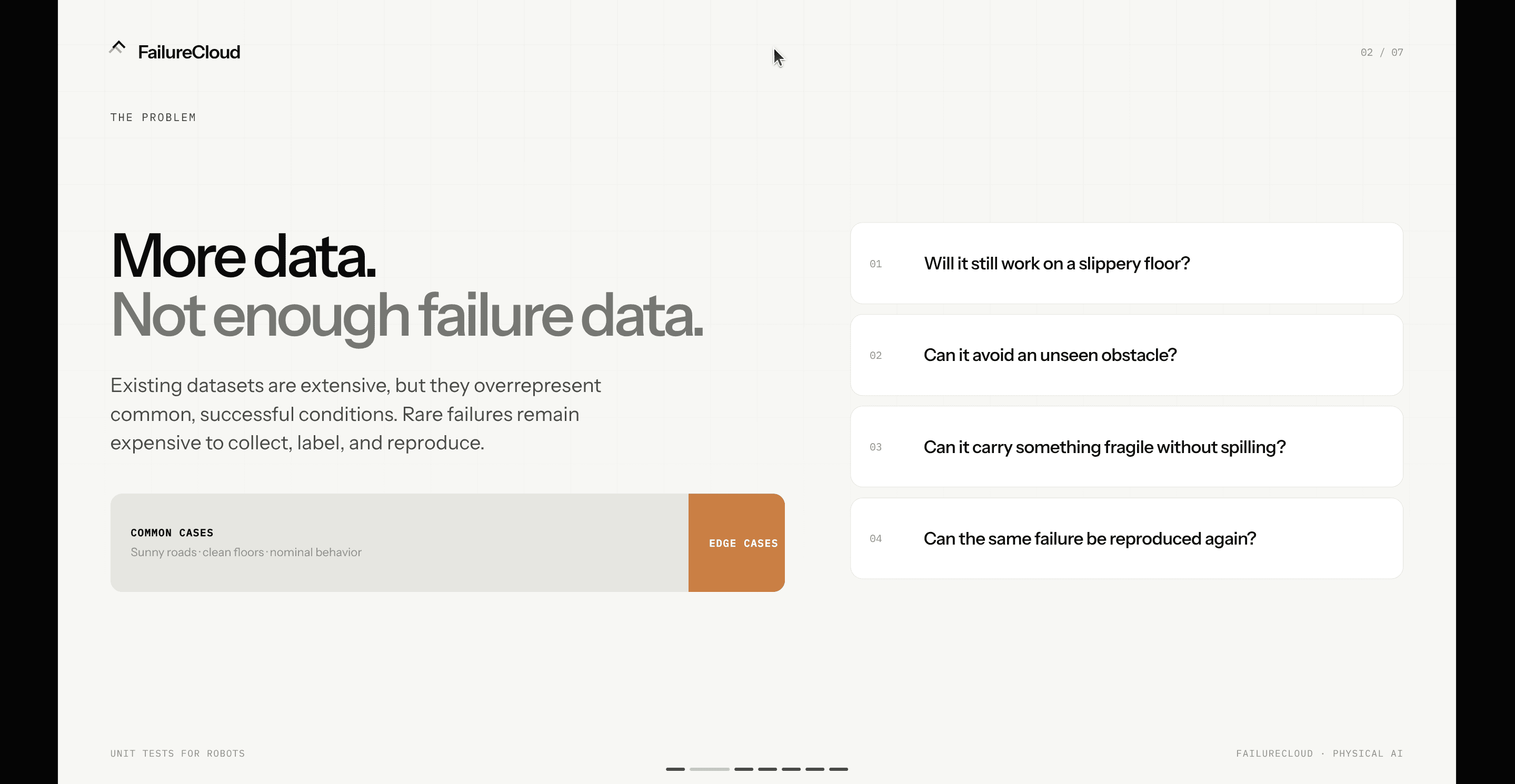
Robots fail in rare edge cases, not normal demos. FailureCloud generates 3D robot unit tests with sensor data, labels, rewards, and pass/fail reports - like carrying a cup of water on a slippery floor.

  • Next.js
  • React
  • Three.js
  • FastAPI
  • PyBullet
  • Claude
  • Redis
  • NumPy

Overview
Unit tests for robots before real-world failure.

FailureCloud helps robotics teams test the cases that clean demos rarely cover: slippery floors, dropped obstacles, noisy sensors, bad lighting, occlusion, and fragile object handling.

Instead of hand-building every simulation, users describe a normal robot task, choose from generated failure scenarios, tune parameters, run the scenario, and export a reproducible test bundle for analysis or training.

System Flow
From prompt to executable edge-case test.

The core design is a simulator-independent scenario contract. Claude can compile a natural-language request into structured failure scenarios, while deterministic templates keep the workflow usable when external services are unavailable.

PyBullet is the current execution adapter, but the contract is designed so the same scenario can be exported toward tools like Isaac Sim, Gazebo, CARLA, ROS-style folders, and OpenPCDet datasets.

What it captures
Sensor evidence, labels, rewards, and pass/fail reports.

Each run records synchronized robot evidence and evaluation data, so teams can understand not just that a robot failed, but why it failed and whether the same edge case can be reproduced.

  • Environment, robot, route, hazards, and custom URDFs
  • RGB, depth, segmentation, LiDAR, labels, and telemetry
  • Collision checks, cup stability, water retention, rewards, and success criteria
  • Export bundles for replay, datasets, simulator configs, and cloud job manifests
Build
A web workflow on top of simulation and export adapters.

The frontend was built with Next.js, React, TypeScript, Three.js, React Three Fiber, SWR, and Playwright. It covers the seven-step workflow from prompt entry through scenario editing, preview, run inspection, and export.

The backend uses FastAPI, Pydantic, PyBullet, NumPy, Pillow, Redis, and Claude. The main engineering challenge was avoiding simulator lock-in by separating scenario intent, simulation execution, recorded evidence, and export delivery.